
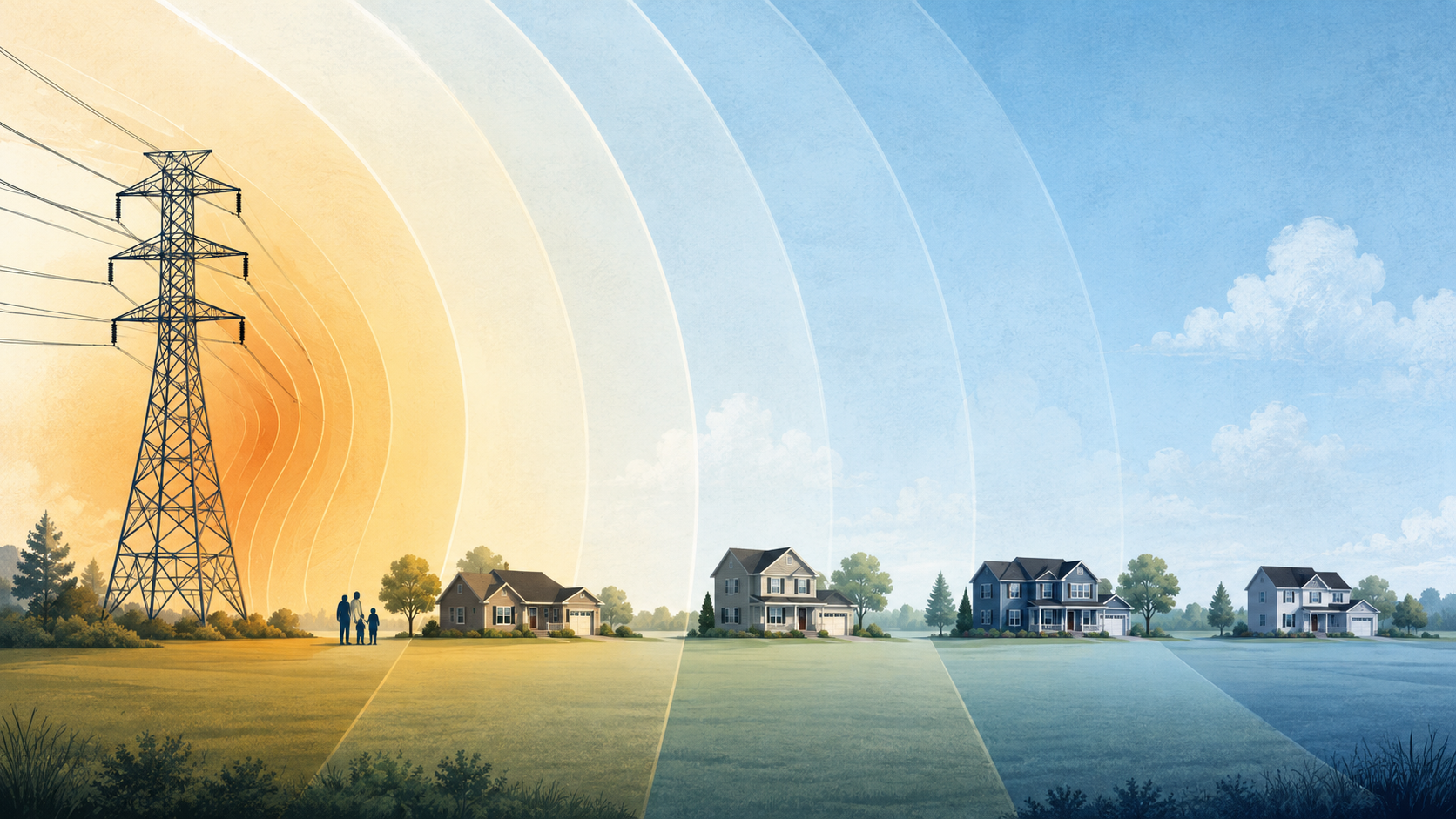
The study included 182 children with leukemia and 726 matched controls, ages 0–15, in Modena and Reggio Emilia. Researchers assessed the home at diagnosis and adjusted for selected traffic, fuel, land-use, transformer, and demographic factors.
Adjusted result by distance band
The cards below report the study’s multivariable odds ratios for all childhood leukemias. An odds ratio of 1.0 is the reference. A confidence interval that crosses 1.0 does not exclude no association.
The largest adjusted estimate, but based on few children and compatible with anything from lower to substantially higher odds.
8 cases / 15 controlsNo excess was evident in this band; the confidence interval remained wide.
7 cases / 33 controlsThe adjusted estimate was close to the distant reference group.
17 cases / 75 controlsThis was the comparison group. It does not mean zero magnetic-field exposure or zero leukemia risk.
150 cases / 603 controlsWhat “harmful effect” means here
This was an observational association, not a demonstration of biological injury at a stated number of metres. The study cannot tell whether moving a particular home changes a child’s risk, and distance alone cannot reconstruct line current, wiring, time spent at home, or other field sources.
In this dataset, the adjusted estimate was highest for homes within 100 m of a high-voltage line.
The paper does not establish a universal setback distance, an individual diagnosis, or a causal threshold.
The authors note that ELF magnetic fields are classified by IARC as possibly carcinogenic, based on limited human evidence.
Source and editorial note
- Malagoli C, et al. Residential exposure to magnetic fields from high-voltage power lines and risk of childhood leukemia. Environmental Research. 2023;232:116320. Read the open-access paper
Source review completed 3 September 2026 from the supplied paper. The illustration is explanatory and not to scale. No independent expert review is claimed. This page is general information, not medical, environmental, property, or legal advice.