
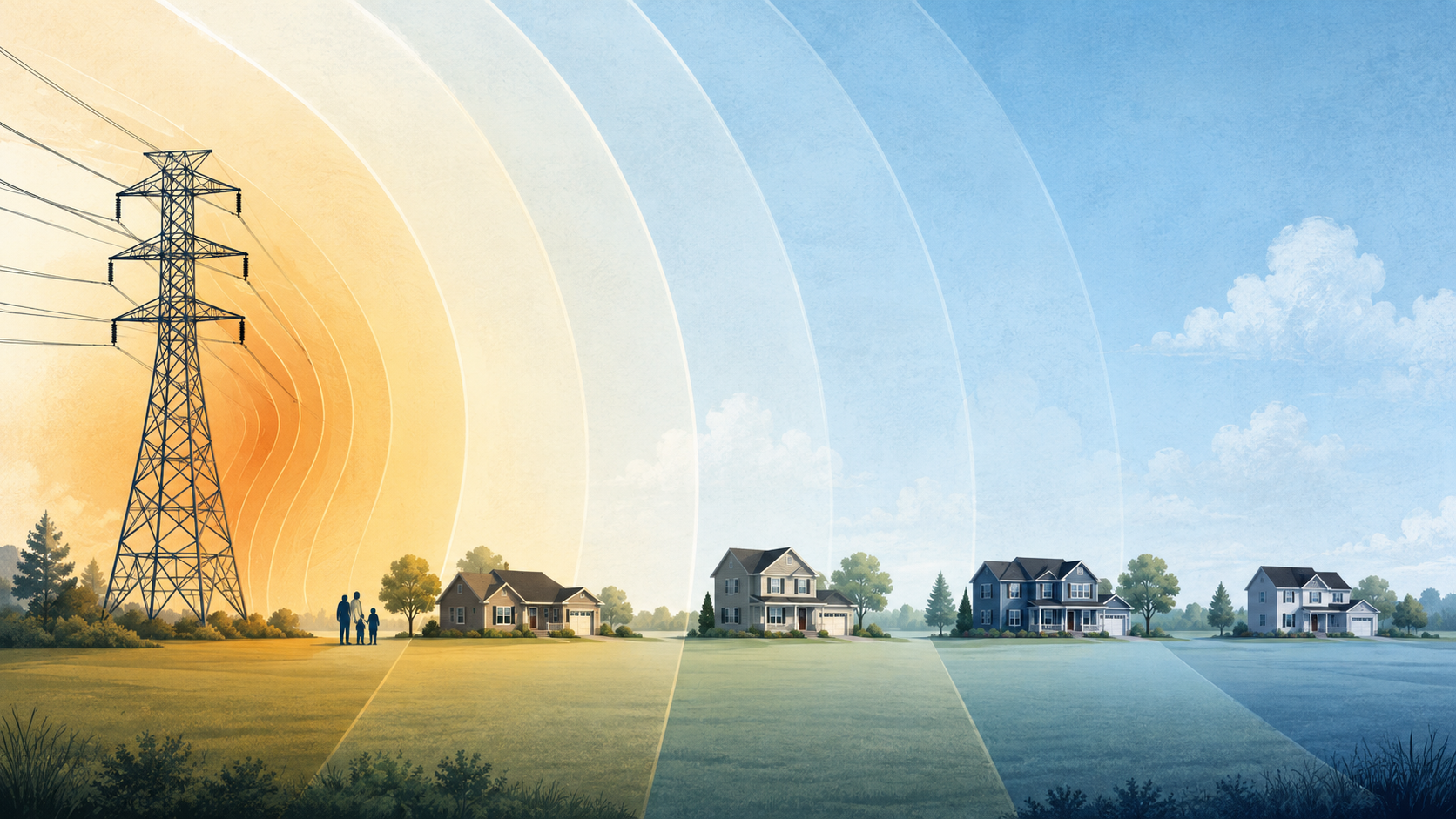
Illustrated evidence brief
Childhood leukemia
Northern Italy: adjusted OR 2.0 for homes under 100 m versus 400 m or more (95% CI 0.8–5.0).
The closest band contained only 8 cases and 15 controls, and the interval included no association.Ethical, physician-aware medical research support
Global research funding call · Region XII, Philippines
ProWrite is seeking up to ₱1,600,000 for a 12-month Phase 1 study that will validate transmission-corridor geography, measure residential extremely low-frequency magnetic fields, and build an ethics-ready foundation for larger health research in Region XII, Mindanao.
These original explanatory illustrations summarize the two uploaded studies. Select either image for the full ProWrite evidence brief, or follow the article link beneath it to verify the published paper.
Northern Italy: adjusted OR 2.0 for homes under 100 m versus 400 m or more (95% CI 0.8–5.0).
The closest band contained only 8 cases and 15 controls, and the interval included no association.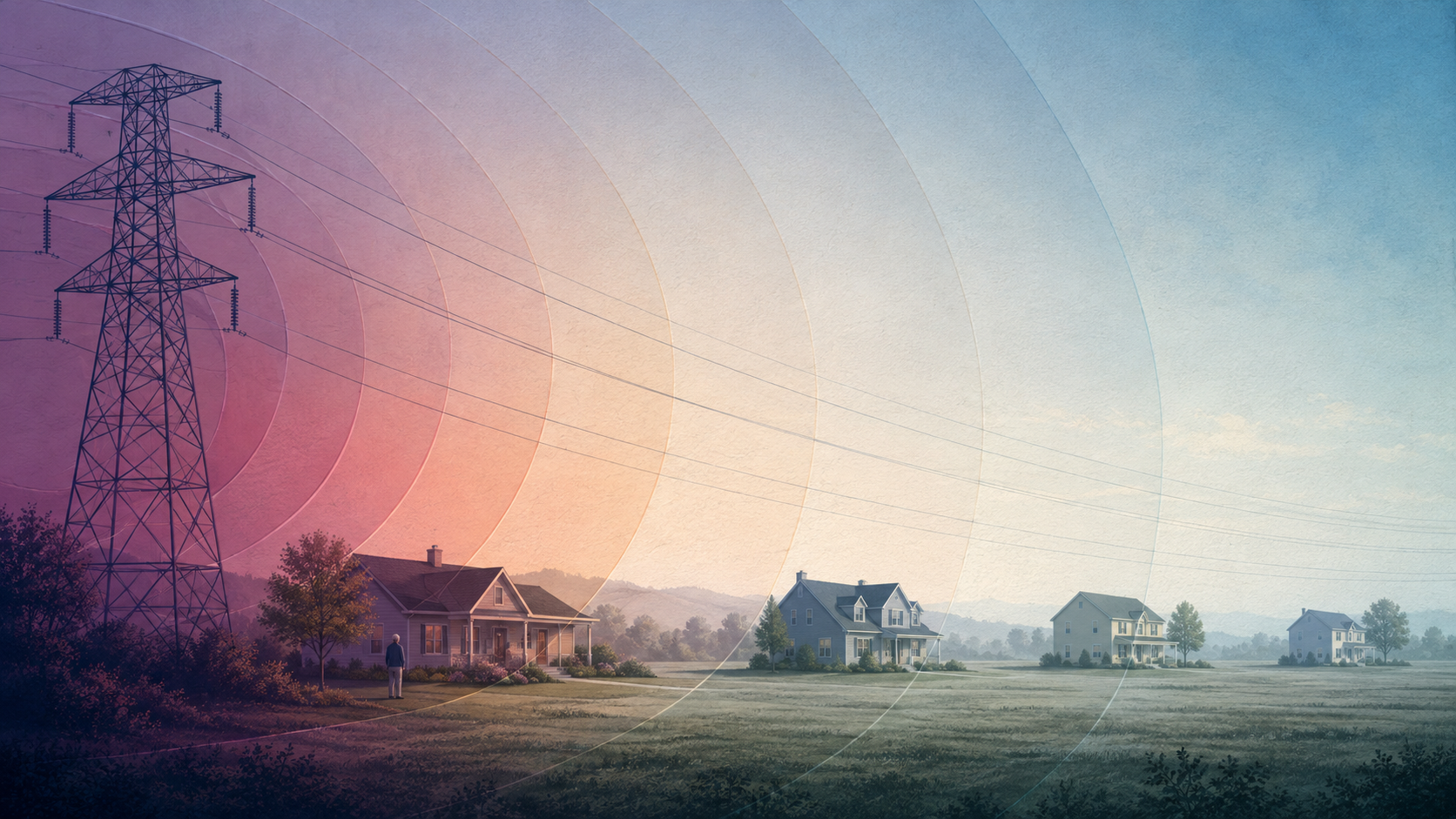
Switzerland: HR 1.54 for Alzheimer’s-disease mortality per 1 µT higher modeled long-term HVPL exposure (95% CI 1.23–1.92).
The outcome was mortality, not a new diagnosis, and the authors state that causal inference remains limited.The illustrations are explanatory and not to scale. They do not show measured exposure at a particular home, an individual’s probability of illness, or a medically established danger zone.
The planning map identifies 163 barangays across 27 cities and municipalities intersected by mapped 69–230 kV transmission corridors. Those counts define a fieldwork starting point—not a health-risk map.
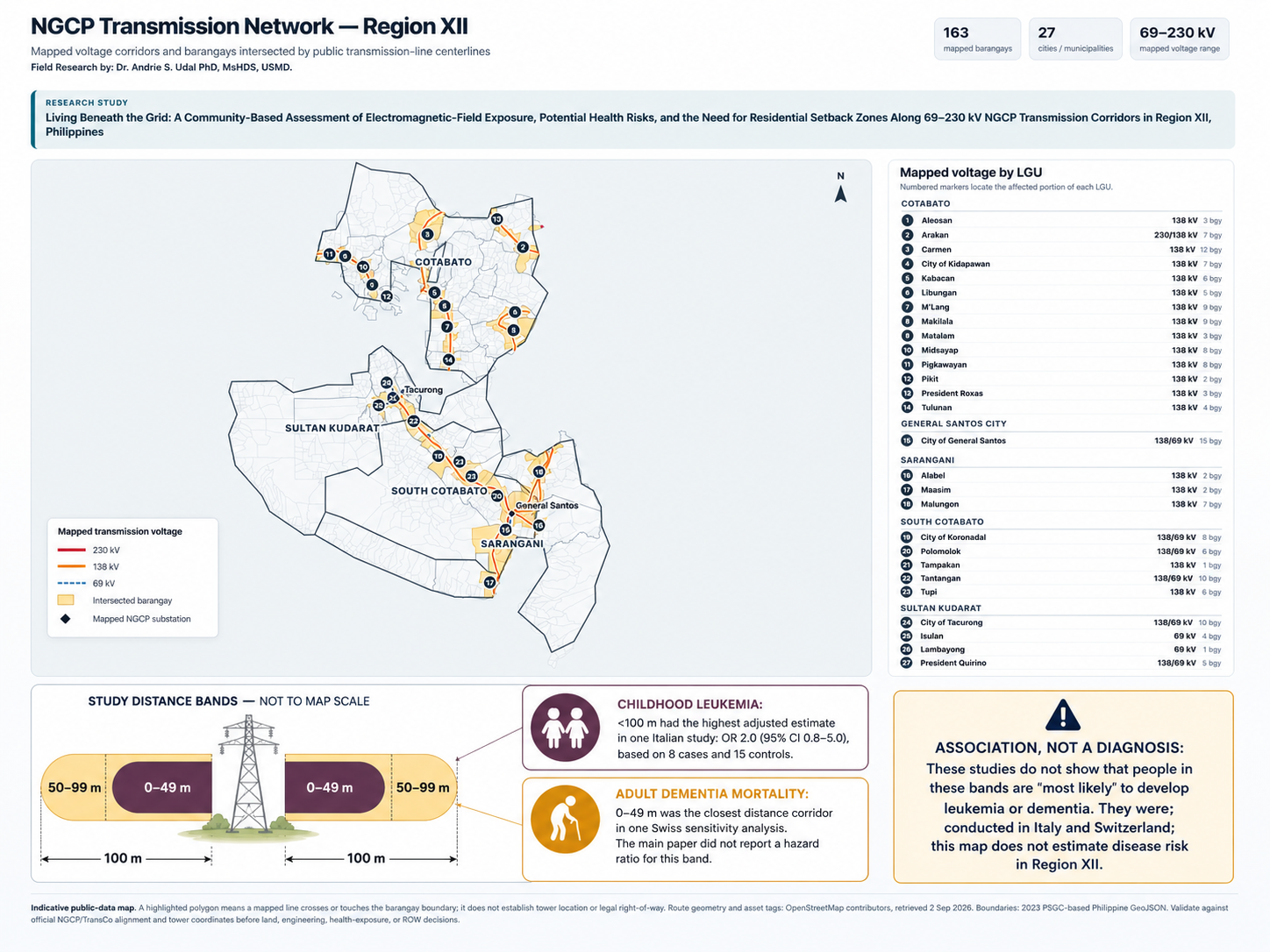
Studies in Italy and Switzerland provide hypotheses and useful measurement models. They do not predict which people will become ill, establish a safe distance, or substitute for Philippine exposure and health data.
Adjusted estimate for homes under 100 m versus 400 m or more in one Northern Italian case-control study; 95% CI 0.8–5.0.
Only 8 cases and 15 controls were in the closest band. The interval included no association.Alzheimer’s-disease mortality per 1 µT increase in modeled long-term HVPL exposure in one nationwide Swiss cohort; 95% CI 1.23–1.92.
This is not the hazard ratio for the 0–49 m band, and mortality is not the same as diagnosis or symptoms.No result shown here estimates leukemia or dementia risk for residents of Region XII.
The proposed study begins with local exposure measurement and feasibility—not a predetermined conclusion.Can Region XII support a scientifically valid, ethically governed, and adequately powered study of residential transmission-line magnetic-field exposure and selected health outcomes—and what design would that larger study require?
The studies below were selected for direct relevance to residential power-line distance, modeled or measured ELF magnetic fields, childhood leukemia, or dementia and neurodegeneration. Each item reports the published result—not a prediction for Region XII.
How to read this list: a positive association can be affected by chance, bias, confounding, or exposure error. A null study does not prove zero risk. Confidence intervals and study design matter more than a headline.
The two uploaded papers plus three influential studies that shaped the distance, exposure, and duration questions.
The adjusted odds ratio was 2.0 for children living under 100 m from a high-voltage line versus 400 m or more (95% CI 0.8–5.0).
Only 8 cases were in the closest band; the wide interval included no association and does not establish causation.
Malagoli, C., Malavolti, M., Wise, L. A., Balboni, E., Fabbi, S., Teggi, S., Palazzi, G., Cellini, M., Poli, M., Zanichelli, P., Notari, B., Cherubini, A., Vinceti, M., & Filippini, T. (2023). Residential exposure to magnetic fields from high-voltage power lines and risk of childhood leukemia. Environmental Research, 232, 116320. https://doi.org/10.1016/j.envres.2023.116320
Across 3.56 million adults, each 1 µT higher modeled long-term HVPL exposure was associated with Alzheimer’s-disease mortality (HR 1.54, 95% CI 1.23–1.92) and other-dementia mortality (HR 1.31, 95% CI 1.13–1.52).
These are exposure-model estimates for mortality, not distance-band risks or proof that magnetic fields caused disease.
Sandoval-Diez, N., Loizeau, N., Huss, A., Röösli, M., & Vienneau, D. (2026). Long-term residential magnetic field exposure and neurodegenerative disease mortality: An 18-year nationwide cohort study in Switzerland. Environment International, 208, 110145. https://doi.org/10.1016/j.envint.2026.110145
The summary relative risk was 2.00 for estimated residential magnetic fields at or above 0.4 µT (95% CI 1.27–3.13).
Only 44 cases were in the highest exposure category; the authors said selection bias could explain part of the increase.
Ahlbom, A., Day, N., Feychting, M., Roman, E., Skinner, J., Dockerty, J., Linet, M., McBride, M., Michaelis, J., Olsen, J. H., Tynes, T., & Verkasalo, P. K. (2000). A pooled analysis of magnetic fields and childhood leukaemia. British Journal of Cancer, 83(5), 692–698. https://doi.org/10.1054/bjoc.2000.1376
Compared with birth addresses over 600 m away, leukemia relative risk was 1.69 within 200 m (95% CI 1.13–2.53) and 1.23 at 200–600 m (95% CI 1.02–1.49).
The association extended farther than expected for magnetic fields; the authors identified chance or confounding as possible explanations.
Draper, G., Vincent, T., Kroll, M. E., & Swanson, J. (2005). Childhood cancer in relation to distance from high voltage power lines in England and Wales: A case-control study. BMJ, 330(7503), 1290. https://doi.org/10.1136/bmj.330.7503.1290
Alzheimer’s mortality was higher among people who had lived within 50 m of a 220–380 kV line for at least 15 years (HR 2.00, 95% CI 1.21–3.33).
The overall estimate for everyone within 50 m was imprecise (HR 1.24, 95% CI 0.80–1.92), and the study assessed mortality rather than incidence.
Huss, A., Spoerri, A., Egger, M., & Röösli, M. (2009). Residence near power lines and mortality from neurodegenerative diseases: Longitudinal study of the Swiss population. American Journal of Epidemiology, 169(2), 167–175. https://doi.org/10.1093/aje/kwn297
International pooled analyses and residential studies from France, Denmark, Brazil, Italy, Finland, and five-country transformer data provide essential confirming and countervailing evidence.
Across 12 studies with magnetic-field measurements, the odds ratio was 1.7 above 0.3 µT versus 0–0.1 µT (95% CI 1.2–2.3).
Exposure methods differed among studies, and the pooled association does not identify a causal mechanism.
Greenland, S., Sheppard, A. R., Kaune, W. T., Poole, C., & Kelsh, M. A. (2000). A pooled analysis of magnetic fields, wire codes, and childhood leukemia. Epidemiology, 11(6), 624–634. https://doi.org/10.1097/00001648-200011000-00003
The odds ratio rose to 1.44 at 0.3 µT or more versus under 0.1 µT, but the 95% CI of 0.88–2.36 included no association.
The authors described the newer-study association as weaker and the highest-exposure estimates as imprecise.
Kheifets, L., Ahlbom, A., Crespi, C. M., Draper, G., Hagihara, J., Lowenthal, R. M., Mezei, G., Oksuzyan, S., Schüz, J., Swanson, J., Tittarelli, A., Vinceti, M., & Wünsch-Filho, V. (2010). Pooled analysis of recent studies on magnetic fields and childhood leukaemia. British Journal of Cancer, 103(7), 1128–1135. https://doi.org/10.1038/sj.bjc.6605838
For homes under 50 m from lines of 200 kV or more, the adjusted odds ratio was 1.33 (95% CI 0.92–1.93); calculated magnetic fields were not associated with leukemia.
The small proximity signal was imprecise and was not explained by high modeled magnetic-field exposure.
Amoon, A. T., Crespi, C. M., Ahlbom, A., Bhatnagar, M., Bray, I., Bunch, K. J., Clavel, J., Feychting, M., Hémon, D., Johansen, C., Kreis, C., Malagoli, C., Marquant, F., Pedersen, C., Raaschou-Nielsen, O., Röösli, M., Spycher, B. D., Sudan, M., Swanson, J., … Kheifets, L. (2018). Proximity to overhead power lines and childhood leukaemia: An international pooled analysis. British Journal of Cancer, 119(3), 364–373. https://doi.org/10.1038/s41416-018-0097-7
The pooled odds ratio was 1.01 for exposures at or above 0.4 µT versus under 0.1 µT among 24,994 cases and 30,769 controls.
A meta-analysis spanning three generations of pooled analyses remained imprecise (OR 1.45, 95% CI 0.95–2.20).
Amoon, A. T., Swanson, J., Magnani, C., Johansen, C., & Kheifets, L. (2022). Pooled analysis of recent studies of magnetic fields and childhood leukemia. Environmental Research, 204, 111993. https://doi.org/10.1016/j.envres.2021.111993
Among children under 5, living within 50 m of a high-voltage overhead line was associated with acute leukemia (OR 1.6, 95% CI 1.0–2.7), while modeled exposure at or above 0.3 µT was not (OR 0.6, 95% CI 0.3–1.3).
The authors concluded that magnetic fields probably did not explain the observed distance association.
Mancini, M., Hémon, D., Faure, L., Clavel, J., & Goujon, S. (2025). Residential exposure to magnetic field due to high-voltage power lines and childhood leukemia risk in mainland France—GEOCAP case-control study, 2002–2010. Environmental Research, 278, 121638. https://doi.org/10.1016/j.envres.2025.121638
The odds ratio was 0.76 for living 0–199 m from a 132–400 kV line versus at least 600 m away (95% CI 0.40–1.45).
The study found no higher leukemia risk in either the 0–199 m or 200–599 m distance group.
Pedersen, C., Raaschou-Nielsen, O., Rod, N. H., Frei, P., Poulsen, A. H., Johansen, C., & Schüz, J. (2014). Distance from residence to power line and risk of childhood leukemia: A population-based case-control study in Denmark. Cancer Causes & Control, 25(2), 171–177. https://doi.org/10.1007/s10552-013-0319-5
A 24-hour bedroom measurement at or above 0.3 µT was not associated with ALL (OR 1.09, 95% CI 0.33–3.61); living within 200 m produced an imprecise OR of 1.67 (95% CI 0.49–5.75).
Small numbers and wide intervals limited both the positive and null interpretations.
Wünsch-Filho, V., Pelissari, D. M., Barbieri, F. E., Sant’Anna, L., de Oliveira, C. T., de Mata, J. F., Tone, L. G., Lee, M. L. M., Andréa, M. L. M., Bruniera, P., Epelman, S., Odone Filho, V., & Kheifets, L. (2011). Exposure to magnetic fields and childhood acute lymphocytic leukemia in São Paulo, Brazil. Cancer Epidemiology, 35(6), 534–539. https://doi.org/10.1016/j.canep.2011.05.008
The conditional-model relative risk was 1.1 for apartments above or adjacent to transformer rooms (95% CI 0.3–3.8).
Only 3 highly exposed cases were available, so the authors characterized evidence for an increase as weak but not conclusive.
Crespi, C. M., Sudan, M., Juutilainen, J., Roivainen, P., Hareuveny, R., Huss, A., Kandel, S., Karim-Kos, H. E., Thuróczy, G., Jakab, Z., Spycher, B. D., Flueckiger, B., Vermeulen, R., Vergara, X., & Kheifets, L. (2024). International study of childhood leukemia in residences near electrical transformer rooms. Environmental Research, 249, 118459. https://doi.org/10.1016/j.envres.2024.118459
Ever living within 50 m of a power line was not associated with Alzheimer’s disease overall (HR 1.04, 95% CI 0.69–1.56).
No duration-response pattern was observed; there were only weak age-specific indications.
Frei, P., Poulsen, A. H., Mezei, G., Pedersen, C., Cronberg Salem, L., Johansen, C., Röösli, M., & Schüz, J. (2013). Residential distance to high-voltage power lines and risk of neurodegenerative diseases: A Danish population-based case-control study. American Journal of Epidemiology, 177(9), 970–978. https://doi.org/10.1093/aje/kws334
Within 50 m versus at least 600 m, the odds ratio was 1.11 for Alzheimer’s dementia (95% CI 0.95–1.30) and 1.09 for Parkinson’s disease (95% CI 0.92–1.30).
Both confidence intervals included no association; the authors described the evidence as weak.
Gervasi, F., Murtas, R., Decarli, A., & Russo, A. G. (2019). Residential distance from high-voltage overhead power lines and risk of Alzheimer’s dementia and Parkinson’s disease: A population-based case-control study in a metropolitan area of Northern Italy. International Journal of Epidemiology, 48(6), 1949–1957. https://doi.org/10.1093/ije/dyz139
Living in an apartment adjacent to an indoor transformer station was not associated with Alzheimer’s disease (HR 1.02, 95% CI 0.85–1.22).
This transformer-building design tests residential ELF-MF exposure, but it is not a power-line distance study.
Liimatainen, A., Roivainen, P., Juutilainen, J., Höytö, A., & Naarala, J. (2025). A cohort study on Alzheimer’s disease in relation to residential magnetic fields from indoor transformer stations. Bioelectromagnetics, 46(8), e70031. https://doi.org/10.1002/bem.70031
This budget supports a rigorous feasibility and exposure pilot. A definitive leukemia or dementia risk study would require a separate power calculation, appropriate comparison groups, long-term outcome access, and additional funding.
Finalize the protocol, statistical analysis plan, consent materials, data-management plan, community-engagement process, and independent ethics submission before recruitment.
Approved, preregistration-ready protocol packageReconcile public route geometry with authorized network information and field verification. Define eligible residential clusters without treating a mapped line as a confirmed tower or right-of-way.
Quality-controlled GIS sampling frameUse calibrated meters and standardized repeat measurements to characterize indoor and outdoor fields across prespecified distance strata and times of day.
Auditable exposure-measurement datasetTest ethical recruitment, residential-history collection, covariate capture, and the feasibility of medically verified outcome linkage. Self-report alone will not be treated as a confirmed diagnosis.
Feasibility estimates and full-study designThe maximum cash requirement is ₱1,600,000. If less is secured, the protocol and scope will be formally resized before fieldwork; essential ethics, calibration, data security, and quality-control steps will not be quietly removed.
| Budget line | Maximum |
|---|---|
| Protocol finalization, ethics review, and data-management planning | ₱120,000 |
| GIS validation, sampling-frame development, and field mapping | ₱220,000 |
| Calibrated ELF-MF instruments, calibration, and field measurement | ₱360,000 |
| Community engagement, approved reimbursements, and field logistics | ₱180,000 |
| Pilot health-data collection and record-linkage feasibility | ₱240,000 |
| Secure data management, quality control, and statistical analysis | ₱220,000 |
| Local research-staff training, safety, and administration | ₱120,000 |
| Reporting, open methods, and stakeholder dissemination | ₱90,000 |
| Contingency, released only against documented need | ₱50,000 |
| Total | ₱1,600,000 |
The proposed release schedule ties funds to reviewable outputs. Dates begin only after contracts, ethics requirements, and local permissions are in place.
Protocol, partners, ethics submission, and data agreements.
20% · ₱320,000Corridor validation, pilot sampling, and repeated field measurements.
45% · ₱720,000Data-quality review, feasibility estimates, and prespecified analyses.
25% · ₱400,000Community report, sponsor briefing, and full-scale study protocol.
10% · ₱160,000Every sponsor will receive transparent reporting—but no authority to select participants, change analyses, suppress findings, or delay publication because a result is inconvenient.
Companies, foundations, professional associations, research suppliers, and responsible infrastructure partners may inquire. The combined accepted cash funding will not exceed ₱1,600,000.
Support the complete Phase 1 program or several major work packages under one disclosed agreement.
Fund a defined area such as measurement, field logistics, secure data management, or analysis.
Contribute to a pooled fund with the same independence, disclosure, and reporting conditions.
A countersigned scope, milestone updates, expenditure summaries, a final technical briefing, and factual acknowledgment subject to the agreement and disclosure policy.
Access to identifiable participant data, guaranteed publicity, a health endorsement, control of interpretation, or a right to block unfavorable or null findings.
Request the sponsor brief, line-item budget, governance terms, proposed milestones, and due-diligence documents. Inquiries are welcome from organizations in the Philippines and worldwide.